
Mark Whitmore, General Manager at BOGE Compressors, outlines the routine users of industrial compressed air systems should consider adopting to improve compressed air system performance.

An area where process manufacturers can improve business efficiency, performance and most importantly, the bottom line is in the operation of industrial compressed air systems. There are significant cost and efficiency savings to be made, and these are possible with just a few changes to the way these assets are operated, monitored and maintained for improved compressed air system performance.
Check supply and demand
– For improved compressed air system performance
Subscribe to PII and receive:
Our long-established bi-monthly digital magazine *Process Industry Informer*, featuring exclusive articles, news and updates across the Process Industries, plus commentary from our three industry experts:

Sean Moran

Gavin Smith

Dave Green
PLUS:
- Process Industry Update — our weekly e-newsletter
- PII Podcast
- Special messages from our advertising partners
In many cases, air compressors produce considerably more compressed air than the process that they are feeding requires. Because of the high volume of energy used to produce compressed air, this means that businesses are consuming and paying for significantly more energy than is actually necessary.
This doesn’t have to be the case. Variable speed air compressors work strictly in accordance with the air demand of a process and produce the exact volume of compressed air at the precise pressure required. As a result, the total energy required to produce compressed air is reduced, making the whole process more energy efficient and less costly.
Move to status based maintenance
– For improved compressed air system performance
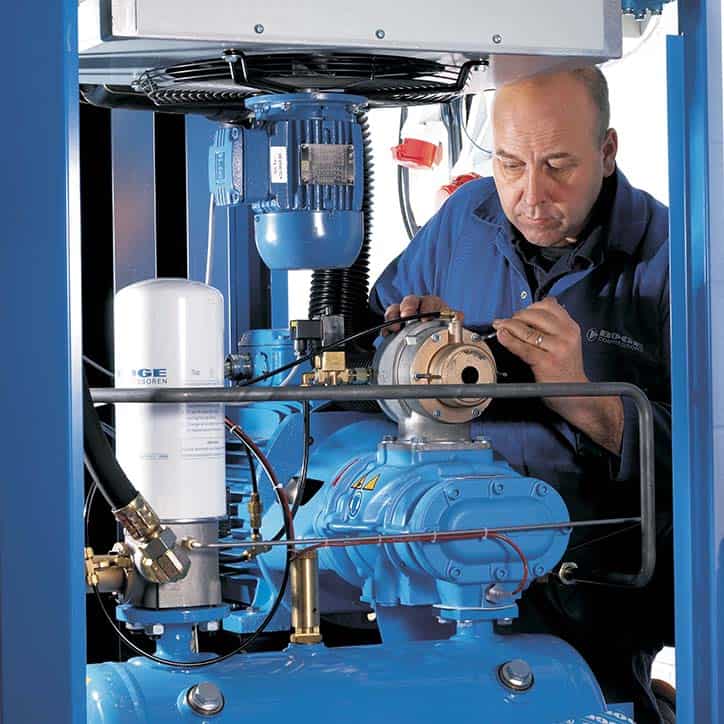
While the planned or routine maintenance approach is still widely used by manufacturers, it has a number of limitations. In the event that parts wear faster than predicted and deteriorate before the time maintenance is scheduled for, the quality of compressed air produced is likely to be reduced and the likelihood of machine failure increases. The knock on effect of this can be disastrous for manufacturers, which may experience negative impact on reputations, safety and productivity.
An alternative to this approach is to implement status based maintenance, whereby the condition of parts within a compressed air system are routinely monitored and replaced only when deterioration has occurred. This option creates a cost saving opportunity since parts are only changed when they need to be, and long term expenses can be reduced by avoiding unanticipated issues and unplanned downtime.
Take advantage of remote monitoring
– For improved compressed air system performance
The advancing of technology has brought about many positives for manufacturers, of which remote monitoring capability should be considered one of the most beneficial. The status and performance of compressed air systems can now be monitored quickly and easily in real-time remotely from anywhere in the world, allowing action to be taken in the event a problem is detected.
By implementing remote monitoring, manufacturers can increase plant efficiency and reduce unplanned downtime and maintenance costs. However, this can only be achieved if those responsible for monitoring do so regularly, analyse relevant data and make informed decisions. Failing to do so and failing to act appropriately based on what the data shows makes the use of remote monitoring systems redundant.
Recover heat
– For improved compressed air system performance
With rising electricity prices to contend with, the need for businesses to improve energy efficiency and cut energy consumption is growing in importance. Air compressors demand high volumes of energy, and of this a high percentage of the energy used is turned to heat and wasted to the atmosphere – 90% in fact, according to The Carbon Trust.
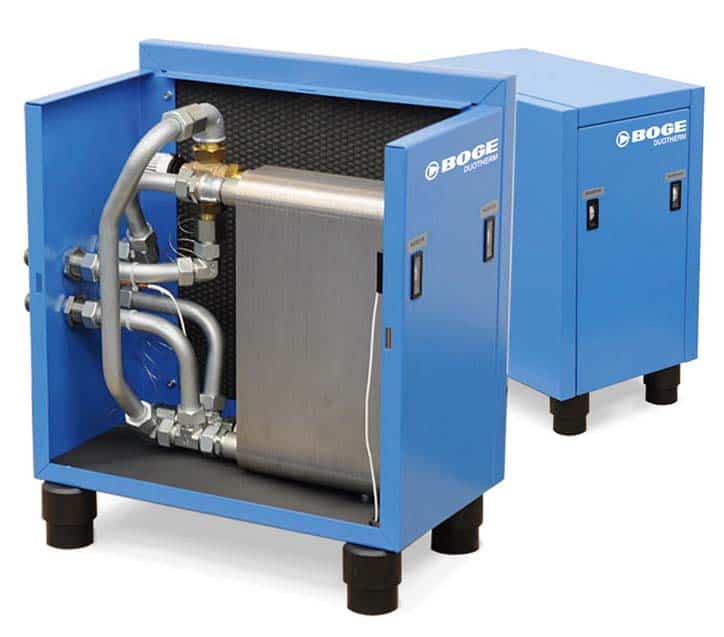
However, by installing an intelligent heat recovery system a high volume of the generated heat that is emitted can be recovered – 94% in the case of systems such as our DUOTHERM. This recovered heat can then be reused for another purpose elsewhere in the plant, such as for ambient heating, water heating or for other production duties.
Comply with pressure systems regulation
– For improved compressed air system performance
In the event that pressure systems fail in use, they can cause serious injury or death to people nearby and cause severe damage to property. This can be extremely detrimental to businesses, with potential lawsuits, fines by regulators and reputations being damaged just a few examples of the possible impact that results from such an occurrence.
To prevent this, a number of regulations and directives are in place to minimise the risks associated with systems or equipment that contain a liquid or gas under pressure. Compliance with these regulations and directives on an ongoing basis is essential if manufacturers are to successfully protect people, property, and the health of the business. Further information on these regulations and directives is available from the Health & Safety Executive (HSE).
Upgrade dryers that use banned R22 gas
In 2015, it became illegal to maintain and service compressed air dryers that use R22 gas. While manufacturers can still operate these dryers for now, at some point they will fail and production and output will be affected.
There’s no benefit to waiting for the dryer to breakdown when it’s going to be replaced anyway, so the best option is to be proactive and upgrade prior to failure. This presents the opportunity to specify a system that suits the specific needs of the business, instead of a system that may have an attractive purchase price but is expensive to operate in the long term.
Generate specialist gases onsite
Many businesses in industry, from medical to mining, opt to purchase specialist gasses such as nitrogen and oxygen from external suppliers. While this may be viewed as the easiest option, it is often not as cost-effective, reliable or safe as producing specialist gases onsite using generators.
By having the generator onsite and permanently at hand, users of specialist gasses are in total control of purity. This means there is the flexibility to generate gas to a level of purity based on the application and what is actually required, instead of investing in optimal purity when it’s not needed.
Additionally, safety risks posed by storing pressurised storage tanks onsite and the potential for late deliveries by an external gas supplier are removed, so users can have peace of mind that employees are safe and gas is always available for use when needed.
Ask the experts
With so much going on in such busy environments, manufacturers don’t need to worry about not having the time or knowledge required to implement changes to their compressed air systems. Instead, compressed air systems experts, whether that’s a local distributor or a systems manufacturer such as us, can help specify and install the right system and technology for any environment or application, allowing manufacturers to focus on their normal day-to-day duties.
Compressed air systems offer an excellent opportunity for energy and cost savings as manufacturers look to boost profitability and gain an edge over the competition. By starting the new year with a new approach that incorporates the resolutions outlined above, manufacturers can benefit from enhanced efficiency and performance – much to the delight of those concerned with the bottom line.


