

As the UK seeks to meet it’s net-zero greenhouse gas emissions by 2050, it seems counterintuitive that as the sitting government actively seeks to shut down UK North Sea oil production, that this same government is approving plans for energy intensive mega AI data centres. Once such AI datacentre is planned to be built near the Elsham Wolds Industrial Estate (reference: Plans for large AI data centre approved, BBC 11 March, 2026 by Holly Phillips).
As reported in 2022 by the OEUK (Reference: Norway is now UK’s primary gas supplier and declining North Sea output means UK faces importing 80% of its gas and oil within a decade, warns OEUK report | Offshore Energies UK (OEUK)), production of UK North Sea oil is and has been declining as the UK enacts it’s net zero plans. Over this same time, oil imports into the UK from the Norwegian sector (from the same North Sea) have been increasing.
Here is another clear example that supply does not drive demand, and that driving down UK oil and gas production isn’t driving reduced consumption. The UK government energy and net zero policy actively strangles investment within the UKCS, directly costs jobs, and is driving those UK businesses that service the UK Oil Industry to the wall.
Subscribe to PII and receive:
Our long-established bi-monthly digital magazine *Process Industry Informer*, featuring exclusive articles, news and updates across the Process Industries, plus commentary from our three industry experts:

Sean Moran

Gavin Smith

Dave Green
PLUS:
- Process Industry Update — our weekly e-newsletter
- PII Podcast
- Special messages from our advertising partners
This view is further supported by the 2025 report “IMPACT OF UKCS FISCAL POLICY ON UK ECONOMIC GROWTH” that provided an direct analysis of current government policy (Reference: Impact of UKCS Fiscal Policy on UK Economic Growth 2025) and the bleak outlook for the UKCS under current government related policies. One of the more predominant statements made in this report is:
“The EPL (Energy Profits Levy) has not delivered the expected tax revenue, with less than 40% of the forecast 2022 tax revenue now expected to be achieved in the period from 2023 to 2028”.
How does phasing out UK produced oil and gas, whilst simultaneously importing the shortfall from elsewhere AND planning to significantly increase the UK’s energy demand (in the form of datacentres) work to the endpoint of net zero? Where is the proof that this makes any noticeable positive difference to global climate change?
Whilst oil produced within the UKCS doesn’t necessarily end up for use in the UK, the jobs, profits, and related industries are very much contributors to HMRC. Buying Oil and Gas from elsewhere adds to the UK foreign debt for little to no benefit to HMRC other than in the form of VAT and duty paid by UK consumers from monies mostly already in the UK.
If the UK government is truly committed to net zero, then do so from a position of economic strength would seem easier to achieve, than from economic ruination. It would also seem to make sense to be looking to slow the rate of energy consumption increase, rather than accelerate it, as is the case with AI data centres. Increasing population coupled with an ever-increasing energy demand doesn’t seem to align with Net Zero ambitions.
To put AI datacentre demand into perspective, the International Energy Agency (IEA) has published information on their web portal (Energy demand from AI – Energy and AI – Analysis – IEA). These published energy projections are heading globally towards 1000 TWh by 2030. Currently, (according to statista.com) the UK annual electricity consumption sits on average at about 320 – 380 TWh, and has been downwardly trending as industry and manufacturing in the UK is decimated. Optimistically, renewables (as reported on Gov.UK) were noted as:
“Output from renewable technologies in 2025 increased 6% to a record 152.5 TWh, and a record share of 52.5% of electricity generation. Wind generation also broke previous records, increasing by 4% and contributing a record 87.1 TWh (and a record share of 30.0%). Solar generation was a new record, up 37 per cent to a record 20 TWh, and a new record share of 6.9 per cent.” (Reference: Statistical Release 2 April 2026, Energy Trends March 2026).

Given the high energy draw data centres, then I’d question how the UK can compete within the AI market whilst having among the most expensive energy in Europe? The UK Department for Energy Security and Net Zero (DESNZ) notes in their Statistical Release (26 June 2025) that: “Compared with the EU14, average industrial electricity prices (including taxes and levies) in the last six months of 2024 were highest in the UK. Finland had the lowest industrial electricity prices overall.”
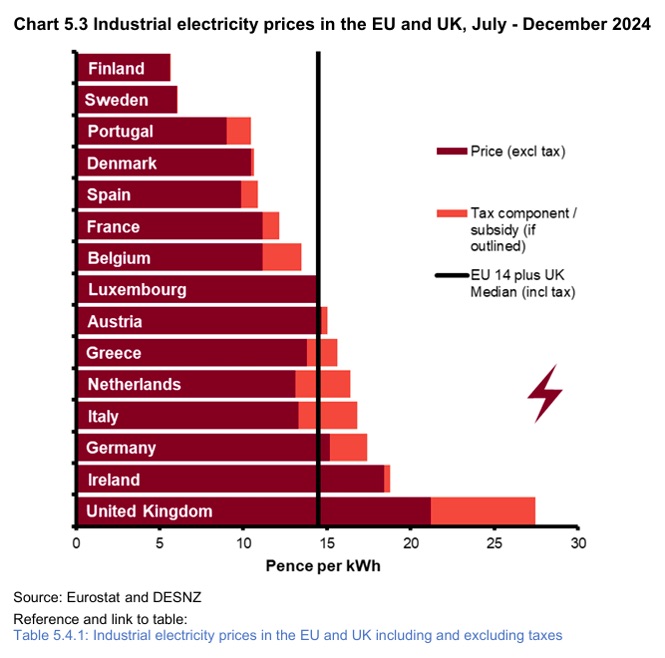
I would also question how net zero can be achieved with a growing population and a growing energy usage of this same growing population; especially if datacentres are going to be the UK’s industry of the future.
Replacing the industry and manufacturing that the UK once had, with a higher energy burden industry in Datacentres might well reverse the downward trend of electricity and push is back up and over the early 2000 levels of 400 TWh. None of that would seem to point towards achieving net zero, nor making any positive impact upon climate change, nor lowering the price of energy in the UK.

Unfortunately, the reality for the UK will probably be to import more oil and gas into the UK as renewables struggle to bridge the gap in energy demand to production. Both importing oil and gas, and the infrastructure and hardware needed for both renewable energy and energy-hungry datacentres is likely to further increase the UK debt rather than help service it. Sitting alongside this is most likely to be a continuation of the UK as having one of the highest energy costs in Europe; hence the choice of pinning an economic future upon datacentres seems even more curious.
Given there hasn’t been so much as a blip from environmental groups as to new oil drilling off the coast of Somalia, (Reference: Somalia set for ‘historic’ first offshore oil drilling, Somalia says it is set for ‘historic’ first offshore oil drilling with help from Turkey) then perhaps the UK might import it’s oil and gas from here rather than from oil reserves within the UKCS? Would environmental groups and the UK Greens be better pleased with that?


