
TL;DR: Why use inline refractometry?
Inline refractometry provides continuous, real-time measurement of liquid concentration using refractive index (RI). Unlike some other measurement methods, refractometry is unaffected by bubbles, foam and suspended solids and is not susceptible to measurement drift.
For process engineers, this makes inline refractometers particularly useful for challenging liquid processes where reliable concentration measurement is required under changing or harsh conditions.
Key advantages include:
Subscribe to PII and receive:
Our long-established bi-monthly digital magazine *Process Industry Informer*, featuring exclusive articles, news and updates across the Process Industries, plus commentary from our three industry experts:

Sean Moran

Gavin Smith

Dave Green
PLUS:
- Process Industry Update — our weekly e-newsletter
- PII Podcast
- Special messages from our advertising partners
- Continuous real-time concentration measurement
- Accurate measurement of Total Dissolved Solids and Brix
- Resistance to interference from bubbles, foam and suspended solids
- No measurement drift
- Minimal maintenance requirements
- Operation with corrosive, abrasive and chemically aggressive liquids
- Suitability for high-temperature and high-pressure processes
- Integration with process control systems through mA, HART and Modbus RTU
- Reduced reliance on manual sampling
- Improved process control, product consistency, energy efficiency and waste reduction
Typical applications include reaction monitoring, endpoint detection, dilution and mixing, dissolving, filtration, cake washing, solvent extraction, distillation, evaporation and product identification.

Accurate, reliable measurements are essential for process control and optimisation, as well as waste reduction, energy efficiency and quality control. However, monitoring can be particularly challenging in many liquid measurement applications, so in the following article Maria Nyman from Vaisala explains when and why inline refractometry can be the ideal solution.
How does inline refractometry measure liquid concentration?
Inline process refractometers are deployed to measure concentration in a wide variety of process liquid applications. The key features of this technology, which is based on the refractive index (RI) of a liquid, are that RI measurement is very accurate, repeatable and reliable, requires almost no maintenance, and can operate in harsh environments.
Why is inline refractometry reliable for process measurement?
RI is a physical property of a liquid that changes with the change of its concentration. It describes the degree to which light bends when entering or passing through the liquid. RI is used within many different industrial processes, providing real-time data that can be utilised to deliver rapid insights for improved process control. In addition to the chemical industry, typical applications include food & beverage, including soft drinks, dairy, brewing and sugar, as well as pulp & paper, semiconductor, oil & gas, CIP (clean-in-place), wastewater, life sciences and many more.
Does foam, bubbles or suspended solids affect refractometer measurements?
In comparison with other liquid concentration measurement methods, the accuracy and reliability of refractometry is supported by its insusceptibility to drift and potential interference from bubbles, foam and suspended solids.
Can inline refractometers continuously measure Brix and Total Dissolved Solids?
Importantly, inline refractometers are able to continuously monitor Total Dissolved Solids and Brix concentrations, and onsite verification is quick and easy to perform using standard RI liquids. Vaisala’s refractometers do not need regular maintenance – just the on-site checks that may be required by customers’ quality systems.
Can inline refractometers measure corrosive and aggressive liquids?
Vaisala’s Polaris process refractometers have been designed to deliver accurate, reliable, repeatable measurements in even the most extreme environments. These include liquids that are corrosive or abrasive, chemically aggressive, or at extreme temperatures and/or pressures. They are also built to withstand environmental challenges such as vibration or contamination, humidity and dust, or any combination of these factors. Ex-certified product versions have been developed for hazardous areas.
Refractometer materials for corrosive and chemically aggressive process fluids
“Accurate, reliable measurements are essential for process control and optimisation”
In order to tolerate harsh environments and chemically aggressive process fluids, the wetted parts of Polaris refractometers feature special materials ranging from stainless steel and higher alloys to ETFE or PTFE (Teflon®). The range includes models that are designed for measuring even high concentrations of aggressive chemicals, such as sulphuric acid, hydrochloric acid, and potassium hydroxide in production pipelines within the chemical, biochemical, metal enriching and life sciences industries. For example, there are versions with a membrane‑lined valve body that has no metallic wetted parts.
How can fouling of an inline refractometer be prevented?
Maintaining sufficient process flow across the prism helps prevent material build-up, while an integrated prism wash system can be used where heavy, sticky or fouling media are present.
Correct refractometer installation with sufficient flow on the prism keeps the prism clean. However, with heavy and sticky media, it is possible to integrate a wash system.
How are inline refractometers integrated into process control systems?
Connectivity options including mA, HART and Modbus RTU allow inline refractometers to be integrated into existing process control and automation systems. Polaris refractometers, for example, can be interfaced directly, or can be connected to a Vaisala Indigo520 transmitter or the Indigo80 handheld meter, which has both analog and digital output capability, as well as data logging and a graphical display.
Inline refractometry vs manual sampling for concentration measurement
By providing continuous measurements, refractometers avoid the need for manual sampling and enable real-time process control. This contrasts starkly with manual sampling which increases costs, incurs delays and risks the measurement of unrepresentative samples.
With applicability to many different processes, refractometers can be implemented in a modular manner, which means that they can be applied to any size of process.
Continuous inline measurement also allows process changes to be detected as they occur rather than waiting for a sample to be collected, transported and analysed. This can enable operators and automated control systems to respond more quickly when concentration moves outside the required process limits.
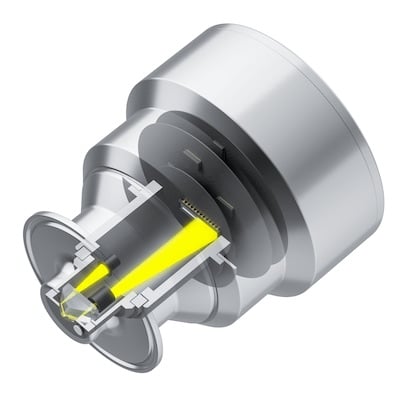
What are the main applications of inline process refractometry?
- Reaction progress monitoring and end-point detection. Refractometers utilise optical technology to follow changes in dissolved components in real-time, showing trends as the reaction proceeds, and indicating the end-point, enabling shorter batch times while improving reaction control, yield, consistency, and waste reduction.
- Dilution/Mixing. Inline refractometers continuously monitor concentration, thereby minimising manual adjustments and off-spec batches.
- Dissolving. When dissolving solid material such as powders or crystals into a solvent, refractometers confirm in real-time when solids are fully dissolved and the target concentration is reached, shortening batch times, improving repeatability and reducing the risk of undissolved residues in downstream processing.
“RI measurement is very accurate, repeatable and reliable”
- Filtration and washing. Suspended solids are commonly removed from liquids through processes like coagulation, precipitation and filtration. Refractometers play a key role in filtration by continuously monitoring dissolved solids in the filtrate to optimise performance. In cake washing, continuous wash medium measurement tracks wash progress and helps identify the endpoint, ensuring the desired purity with reduced wash time and wash liquid consumption.
- Solvent extraction. Refractometers measure the concentration of the solvent (as it dissolves, evaporates and dilutes and needs to be replenished) allowing operators to fine-tune operating conditions, stabilise extraction performance and improve both purity and recovery.
- Distillation. Continuous inline measurement enables tighter control of top and bottom product purity in distillation, improving separation efficiency and reducing both reprocessing needs and energy consumption.
- Evaporation. Refractometers monitor dissolved solids concentration and provide real-time control signals to adjust product flow and steam usage in evaporators. This helps maintain a stable outlet concentration, significantly reducing energy consumption.
- Product identification. For safety reasons and to avoid cross-contamination, it is critical to ensure that the correct liquids are fed to the correct tank during loading, unloading, or custody transfer. In-line process refractometers are able to differentiate liquid chemicals based on their distinctive refractive index.
“By providing continuous measurements, refractometers avoid the need for manual sampling”
When should process engineers consider inline refractometry?
Inline refractometry can be particularly useful when a process requires continuous, accurate concentration measurement and conventional measurement techniques may be affected by changing process conditions.
Applications may be well suited to inline refractometry where liquids contain bubbles, foam or suspended solids, where measurement drift would create process-control problems, or where manual sampling cannot provide sufficiently rapid information about changing process conditions.
It can also provide an effective measurement solution for corrosive, abrasive or chemically aggressive liquids and processes operating at elevated temperatures or pressures, provided that the refractometer and wetted materials are correctly specified for the application.
For processes involving reaction monitoring, mixing, dilution, dissolving, filtration, extraction, distillation or evaporation, continuous refractive index measurement can provide operators and control systems with real-time information about concentration and process progress.
Why inline refractometry is valuable for process control
Liquid processes rely heavily on accurate measurements to improve productivity and product quality, to optimise process efficiency, reduce waste and save energy. However, the achievement of these goals relies on accurate technology that is able to operate continuously and reliably in challenging environments. Robust, accurate and reliable, with minimal maintenance requirements, refractometry represents the ideal measurement solution for many applications.
For process engineers dealing with difficult liquid measurement applications, inline refractometry therefore offers a practical route to continuous concentration measurement without many of the interference, drift and maintenance challenges associated with alternative measurement methods.
Frequently Asked Questions about Inline Refractometry
What is inline refractometry?
Inline refractometry is a method of continuously measuring the concentration of a process liquid by measuring its refractive index (RI). The refractometer is installed directly within the process so measurements can be made continuously without relying on manual sampling.
How does an inline refractometer measure liquid concentration?
An inline refractometer measures how light bends as it interacts with a process liquid. This refractive index changes as the concentration of dissolved components changes, allowing the instrument to determine and continuously monitor liquid concentration.
Are inline refractometers affected by bubbles or foam?
Refractive index measurement is insensitive to interference from bubbles and foam, making inline refractometry suitable for process applications where these conditions can present difficulties for other measurement technologies.
Do suspended solids affect refractometer measurements?
Inline refractometry measures dissolved components and is insensitive to interference from suspended solids. This makes the technology useful in processes where suspended material may be present alongside the dissolved components being measured.
Can an inline refractometer measure Brix?
Yes. Inline refractometers can continuously monitor Brix concentration in process liquids, making them useful in applications including food and beverage production, brewing, dairy and sugar processing.
Can refractometers measure Total Dissolved Solids?
Yes. Inline refractometers can continuously measure Total Dissolved Solids by monitoring changes in the refractive index of the process liquid.
Can refractometers measure corrosive chemicals?
Process refractometers designed with suitable wetted materials can measure highly corrosive and chemically aggressive liquids. Applications can include sulphuric acid, hydrochloric acid and potassium hydroxide as well as other challenging process chemicals.
Can inline refractometers operate at high temperatures and pressures?
Process refractometers can be designed for demanding industrial environments including applications involving elevated temperatures and pressures. The appropriate instrument and wetted materials should be selected according to the process conditions.
How much maintenance does an inline refractometer require?
Inline refractometers typically require very little routine maintenance. Correct installation and sufficient flow across the prism can help keep it clean. Heavy or sticky process media may require an integrated prism wash system.
Can an inline refractometer replace manual sampling?
In many concentration measurement applications, inline refractometry can significantly reduce reliance on manual sampling by providing continuous real-time measurements directly from the process. This avoids sampling delays and reduces the risk of measurements being based on unrepresentative samples.
What processes can inline refractometry be used for?
Typical applications include reaction progress monitoring, endpoint detection, dilution and mixing, dissolving, filtration, cake washing, solvent extraction, distillation, evaporation and product identification.
How can an inline refractometer connect to a process control system?
Industrial refractometers can support connectivity options such as mA, HART and Modbus RTU, allowing concentration measurements to be integrated with process control and automation systems.


